

19 Aug The Restorative Power of Water
What Refuge at Castle Pines Taught us about Healing
Charles Moore wrote his doctoral thesis on water. Not on a building, not on a city — on water, and on its particular power to move the mind somewhere else entirely. He put it simply: water carries our thoughts from wherever we are standing to all the water in the world.
That idea is the fourth lesson we are exploring in our ongoing series on what Moore taught us, and it is the one that comes closest to something you feel in your body before you understand it in your mind. Water does not just occupy a site, and it is not only something to look at. It changes the state of the person standing near it.
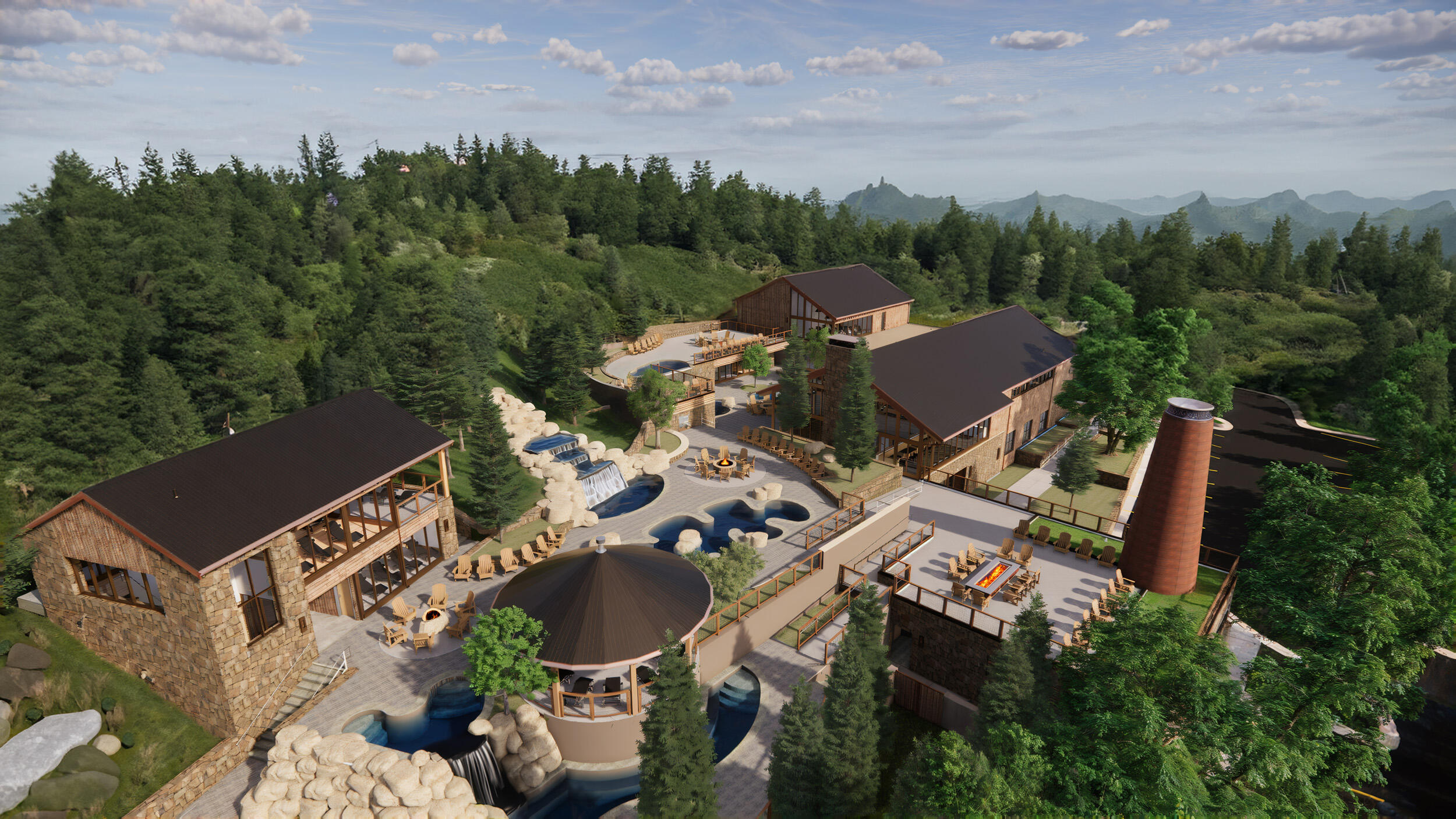
Nowhere in our portfolio is that principle tested more directly than at Refuge, a Nordic spa we designed for a wooded hillside in Castle Pines, Colorado, the first time we built an entire architecture around water’s restorative power rather than its visual one. The design reached the point of permit, but never reached construction. What survives in our Portfolio is a complete thought: a full demonstration of water as the mechanism of a controlled, designed sequence of healing.
Water as a rhythm the body learns
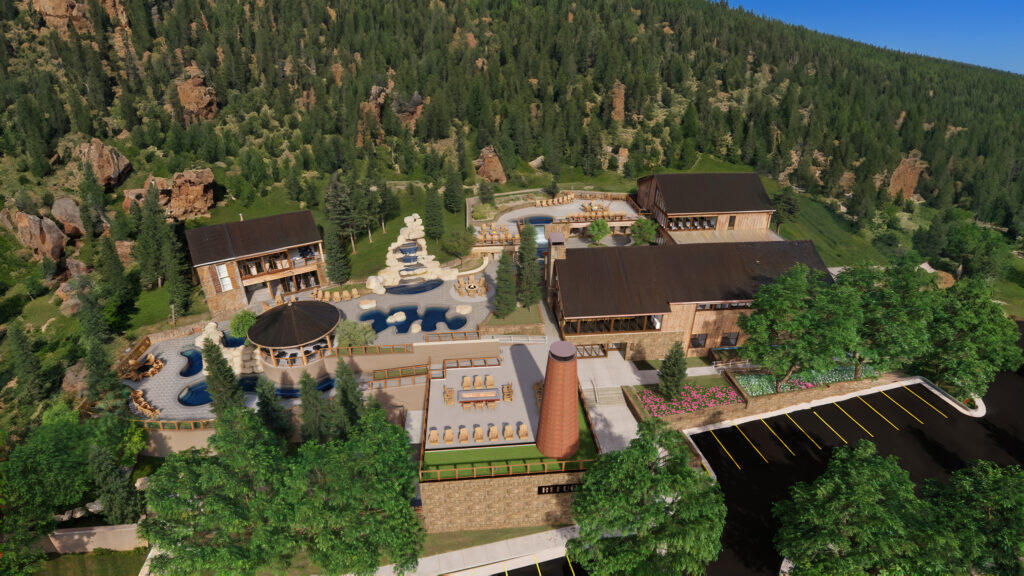
Refuge was conceived around the Nordic bathing tradition, which is built on contrast: heat, then cold, then rest, repeated until the body comes to recognize the pattern and surrender to it. This is where water stops being decorative and becomes therapeutic — the temperature of the water, not its appearance, is doing the work. The architecture had to hold that rhythm without announcing it. Outdoor hot and cold pool decks were framed by landscaped water features and natural stone, so that the shift from one temperature to the next felt like moving through a landscape rather than following a program. Saunas and steam rooms in accessory structures extended the sequence further, so a guest could move through an entire day of contrast and recovery without the experience ever feeling engineered.
This is where Moore’s thesis becomes practical rather than poetic. Water led the design, not as a view to be framed but as a physiological experience to be choreographed. The architecture followed — stepping with the terrain, preserving the tree canopy, letting the site’s own topography set the pace of a person’s movement from one thermal condition to the next.
Water as permission to rest
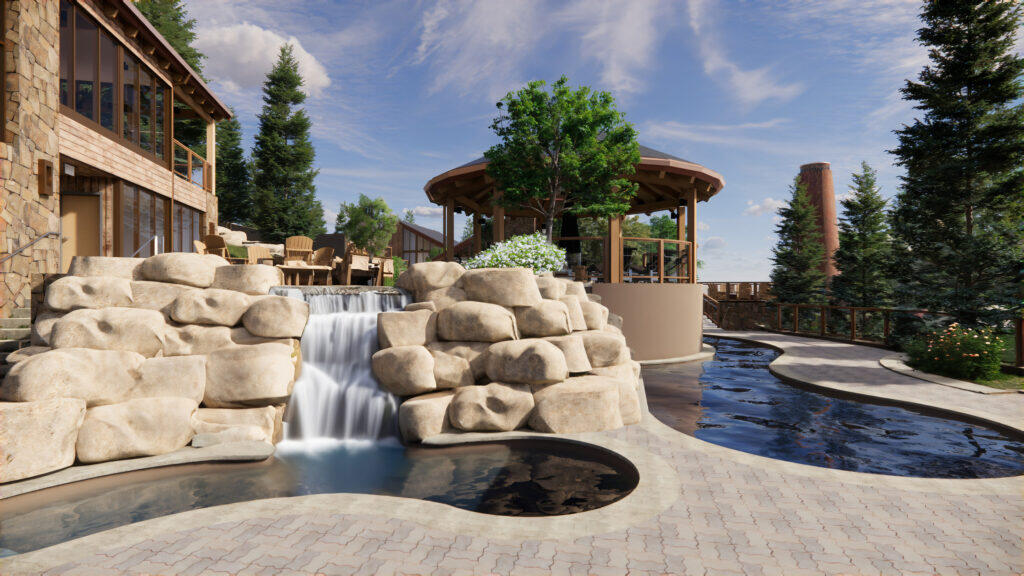
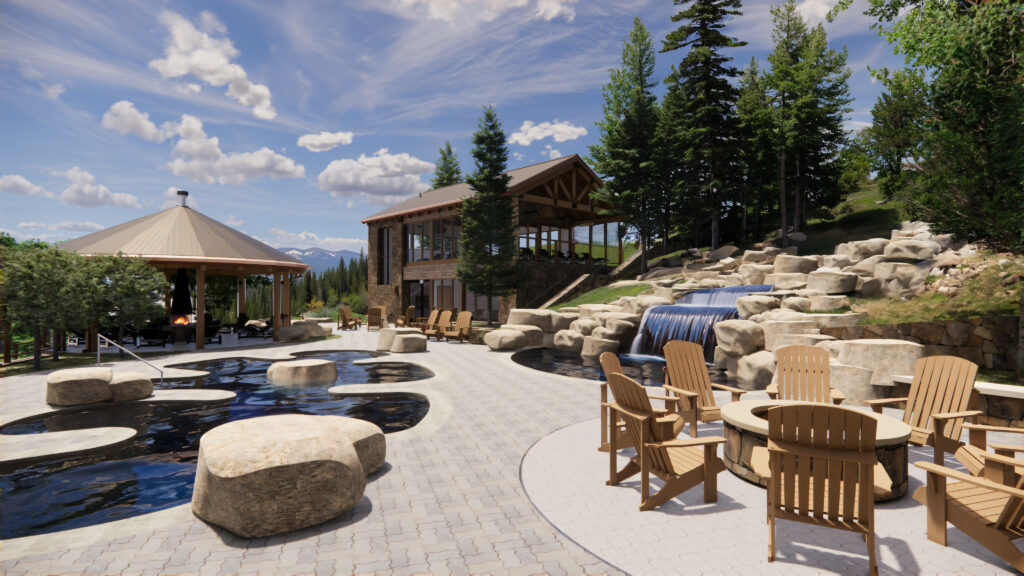
An open-air gazebo offered sheltered outdoor relaxation between circuits, positioned so that a guest could rest within sound of moving water without needing to seek it out. Paired with sculptural fire pits and scent gardens — developed in collaboration with Bill Newman of DHM Design — the grounds were built to work on more than one sense at once. Water was rarely alone in a moment. It was always working with warmth, or fragrance, or stone, to hold a guest in a state of rest rather than simply provide a place to be in. That layering is what separates a restorative design from a decorative one: the water is not asking to be noticed. It is asking to be felt.
Even the project’s infrastructure deferred to that priority. The pool equipment building was tucked below grade into the hillside, so that nothing mechanical interrupted the quiet the water was there to create. A corten steel smokestack was the one element allowed to rise and announce itself — a single vertical gesture against an otherwise horizontal, land-hugging composition built entirely in service of stillness.
What the sequence still teaches
Moore was right that water leads our thoughts to all the water in the world. At Castle Pines, we tried to design a place where that was the entire point — where every threshold, every change in temperature, every pause at the water’s edge was placed with intention, and where the architecture’s only job was to get out of the way and let the water do what it has always done.
This post is part of our ongoing series, “What Moore Taught Us” — six lessons drawn from Charles W. Moore’s influence on Hayne Architects across four decades of practice.
Quote source: Charles W. Moore, “Principles & Enthusiasms,” charlesmoore.org.
Project Note: Refuge at Castle Pines was designed and reached ready-to-issue permit status in 2017.
Discover more from Hayne Architects
Subscribe to get the latest posts sent to your email.
