

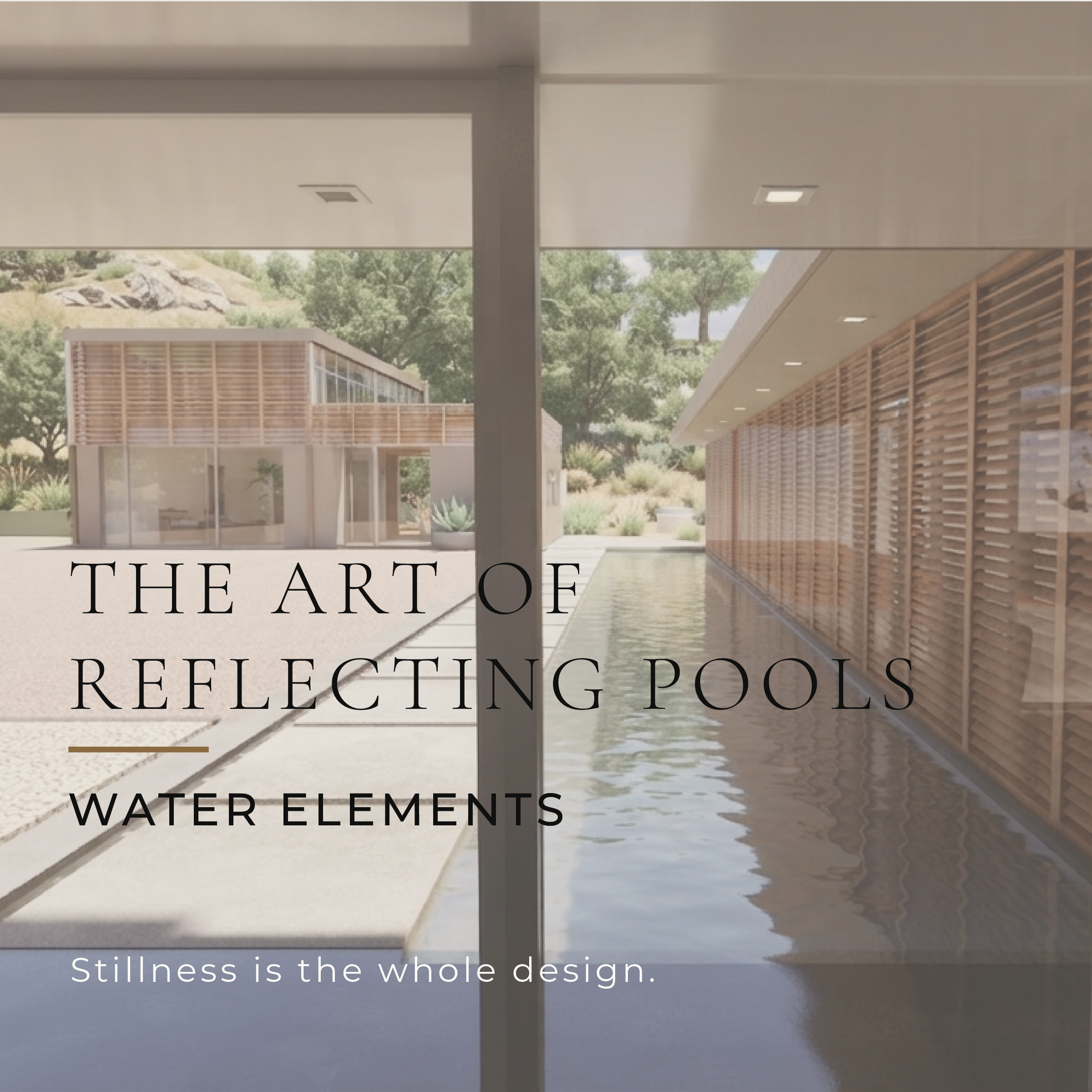
12 Aug The Art of Reflecting Pools
Water, at Hayne Architects, rarely announces itself. It settles. It listens. Nowhere is that philosophy more visible than in the reflecting pool — a feature so quiet in its mechanics that its power is easy to underestimate, and so precise in its effect that a few inches of still water can reorganize an entire composition of a home.
This month we’re looking closely at water as a design language, and we wanted to begin here, with the element that asks for the least and gives back the most: the reflecting pool.
What Makes a Reflecting Pool a Reflecting Pool
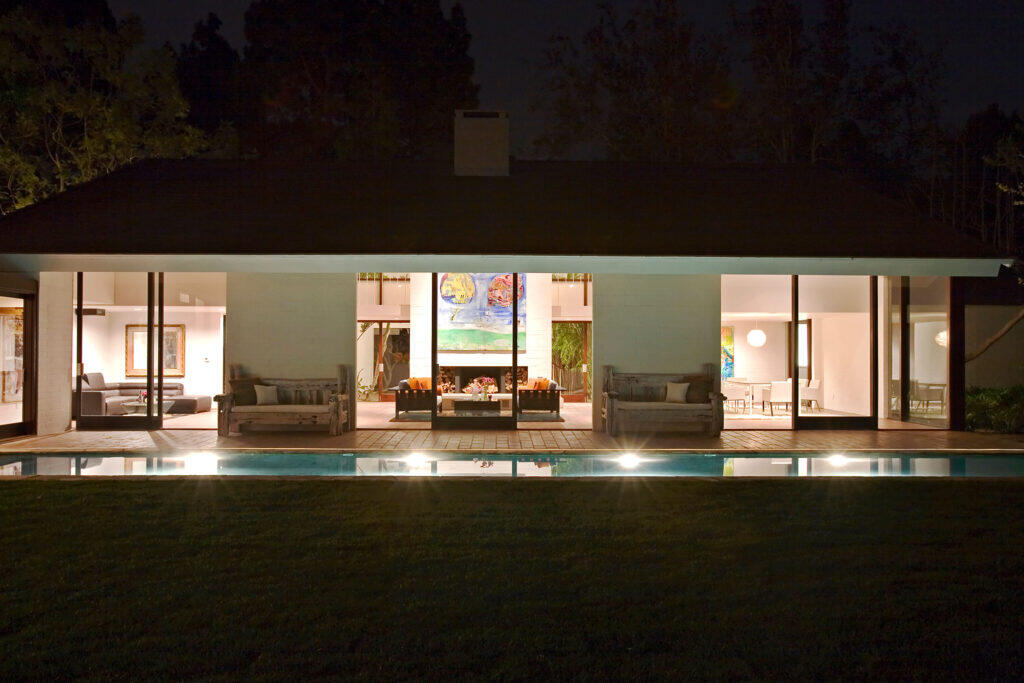
The distinction isn’t really about size — some reflecting pools stretch the length of a motor court, others fit into a six-foot planting bed. The distinction is about intention. A swimming pool is built for entry: bodies displace water, break its surface, animate it. A spa does something similar at a smaller, warmer scale. A reflecting pool is built for the opposite. It exists to be looked at, not stepped into, and everything about its engineering follows from that single decision.
Depth is usually shallow — often just a few inches, occasionally a foot or two — because the goal isn’t submersion, it’s surface. The basin floor is typically finished dark: black granite, dark-troweled plaster, charcoal pebble — because a dark floor absorbs light rather than scattering it, which is what allows the water to behave like glass instead of like a pool. Circulation is engineered to be nearly imperceptible; a reflecting pool with visible turbulence has failed at its one job. And the edge condition matters enormously. Many of the reflecting pools we detail use a knife or weir edge, where water disappears almost invisibly over a thin lip, so there’s no coping line to interrupt the mirror.
None of this is decorative in the ornamental sense. It’s closer to optics. A reflecting pool is really a piece of applied physics dressed as landscape.
How a Reflecting Pool Contributes to Design
The obvious answer is beauty — and reflecting pools are beautiful, doubling a facade, a row of columns, a single sculptural tree, the sky itself. But the more interesting answer, architecturally, is what they do to space.
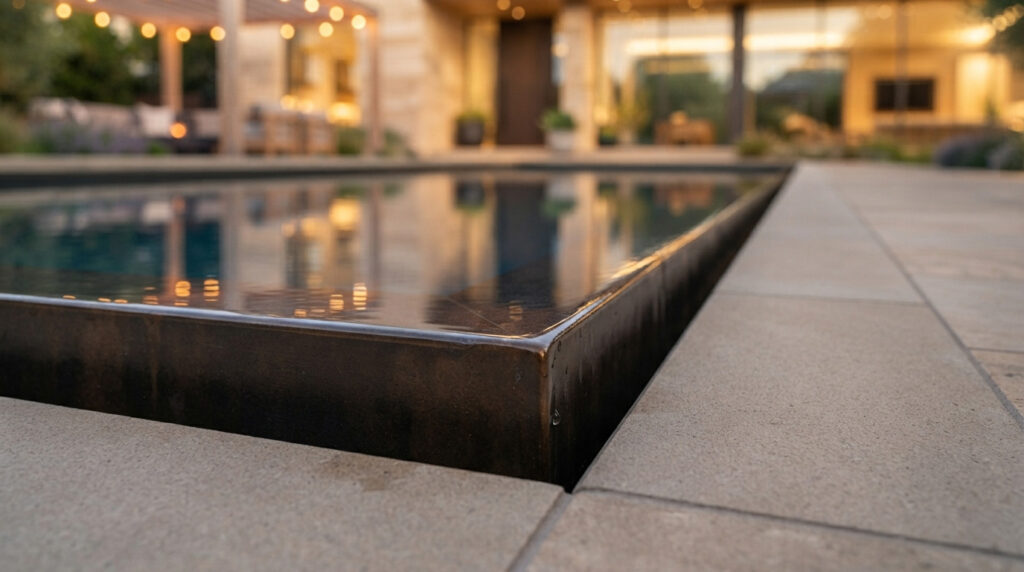
A reflecting pool extends a sightline without extending a floor plan. Placed at the terminus of a hallway or beyond a wall of glass, it reads as an extension of the room — the eye keeps traveling even though the walking stops. That doubled depth is one of the most efficient tricks available to a designer working on a tight or vertically stacked hillside lot, where usable square footage is precious but perceived space still needs to feel generous.
It also does quiet, important work at thresholds. A shallow pool set at an entry — flanking a bridge, running alongside a front walk — signals a transition before a single door is opened. It slows the pace of arrival. There’s a reason reflecting pools appear so often at the edge of courtyards and entry sequences in the projects we design: they’re doing procession, not decoration.
And there’s an acoustic and material effect that’s easy to overlook. Still water absorbs the visual noise around it. Next to a reflecting pool, hard materials — stone, steel, glass — read as calmer, because the water offers no competing texture, no motion, nothing but a held, quiet plane. It’s the same reason a room with one deliberate empty wall can feel more considered than one that’s fully furnished. Restraint reads as intention.
Where They Work Best
Reflecting pools reward specific siting more than almost any other water feature, because their entire value depends on what they’re reflecting.
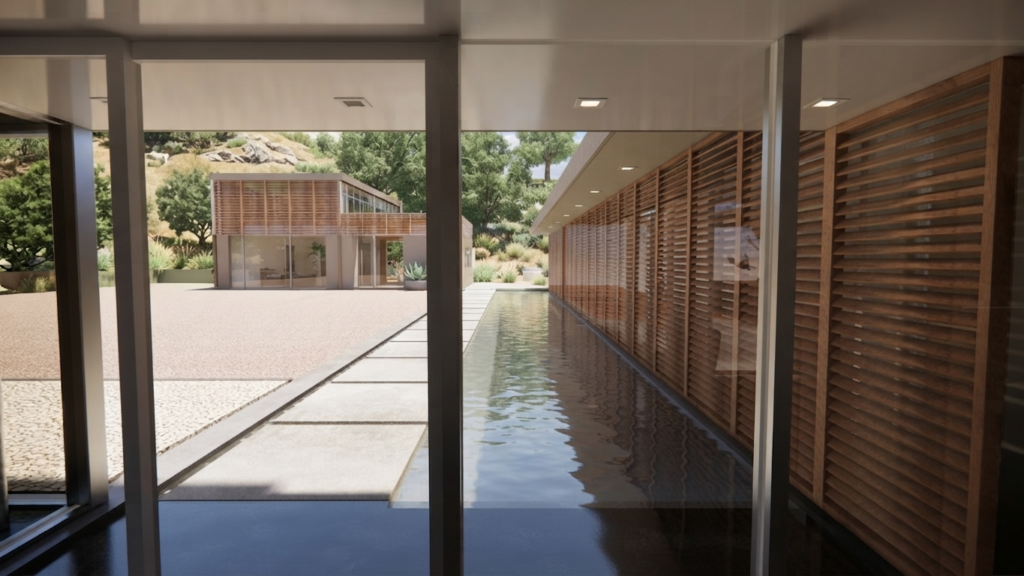
Entry courtyards are a natural home — a pool set just inside a gate or along an entry path gives arrival a moment of pause and, in the right light, mirrors the facade back at a visitor before they’ve even reached the door. Transitional zones between indoor and outdoor living — the strip just beyond a wall of pocketing glass doors — are another, because the pool can appear to run continuously from interior floor to exterior water, blurring where the house actually ends.
They’re also powerful on view-oriented sites, counterintuitively. A pool that sits at the edge of a terrace, positioned to catch an ocean horizon or a mountain silhouette in its surface, effectively gives a homeowner two views for the price of one — the real one, and its inverted twin underfoot. And on hillside or complex-grade sites, a shallow reflecting pool can resolve an awkward level change more gracefully than a retaining wall alone, turning a structural necessity into a considered pause in the landscape.
What they don’t do well is compete. A reflecting pool placed near heavy planting, strong pattern, or another dominant water feature will lose its clarity — the whole effect depends on an uncluttered field around it. The best ones we’ve designed sit in restraint: one material, one edge condition, one wide, unbroken plane of water, asked to do one thing extremely well.
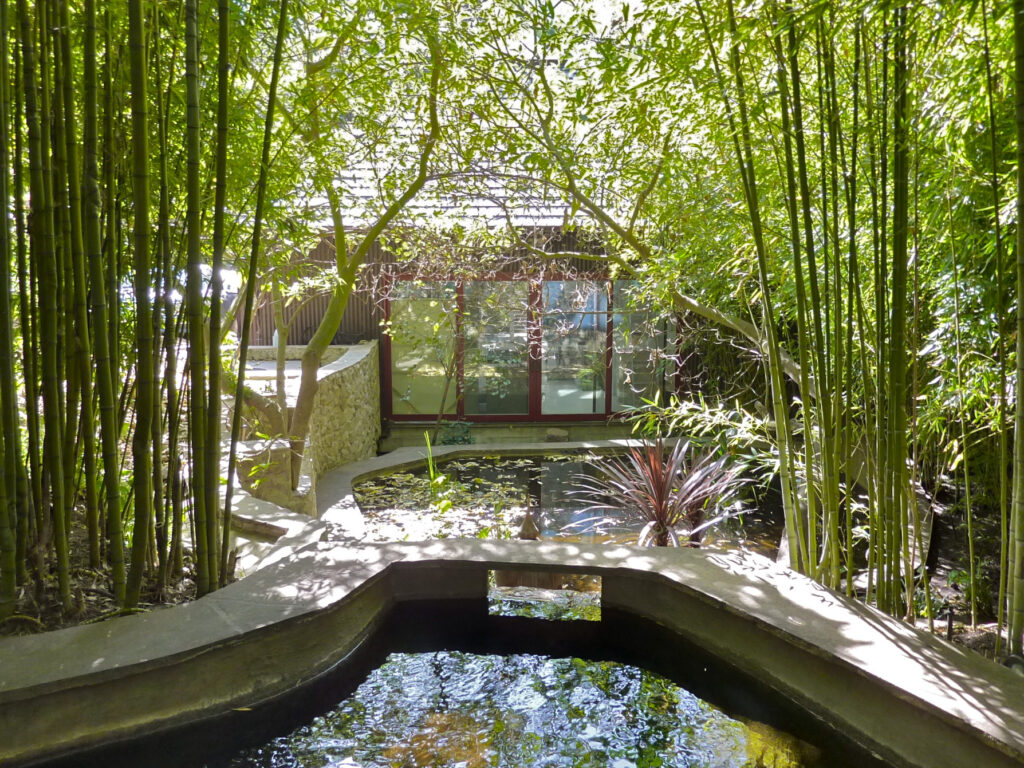
That’s really the throughline of a well-designed reflecting pool, and maybe of good water design generally — it isn’t about how much water you can show someone. It’s about how still you can make it, and what that stillness lets them see.
Discover more from Hayne Architects
Subscribe to get the latest posts sent to your email.
